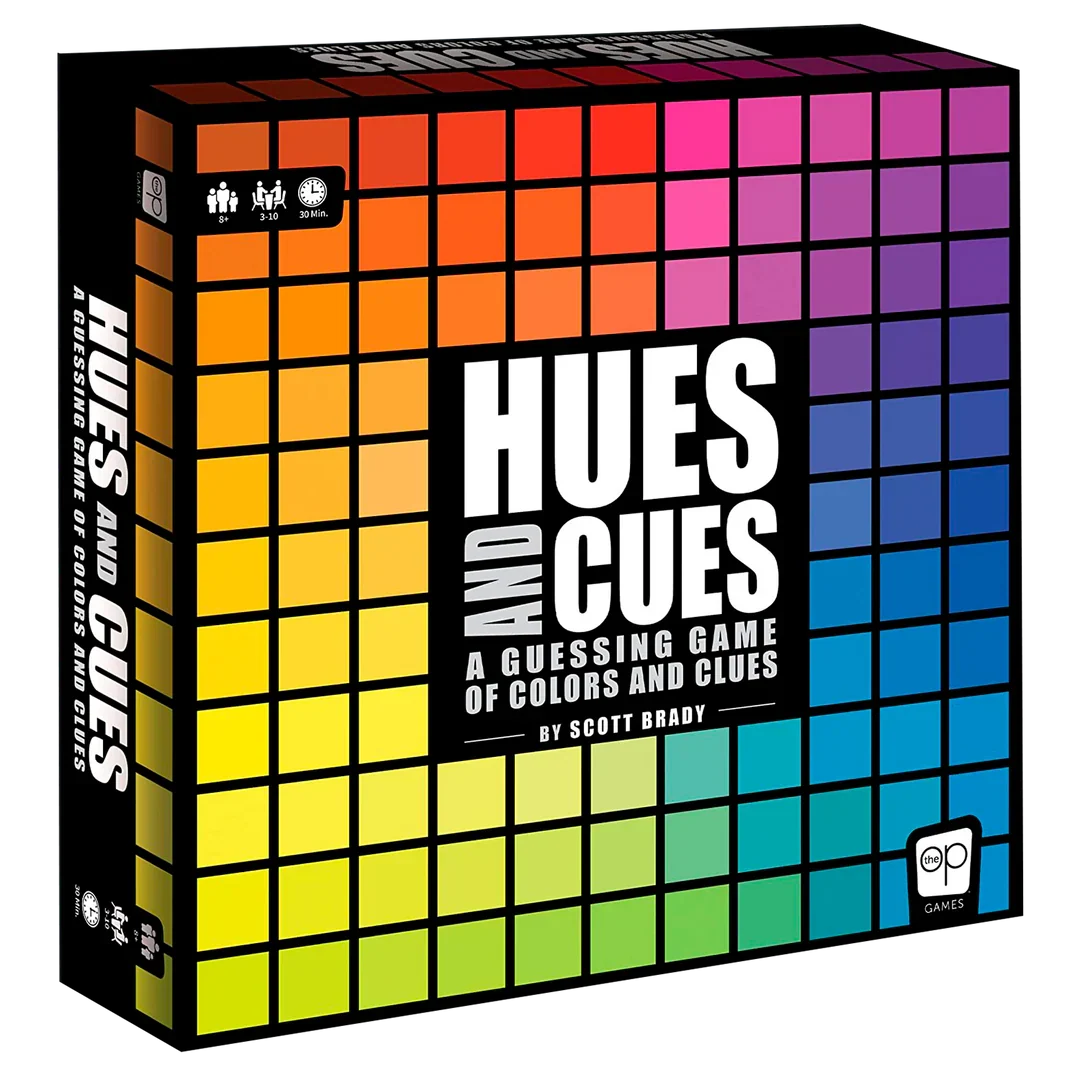


Hues and Cues – The Award-Winning Color Guessing Party Game
Hues and Cues is our award-winning color communication game that brings 3 to 10 players together around a vibrant spectrum board. One player becomes the Cue Giver each round, choosing a specific color on the board and offering two creative clues to help teammates guess it.
We designed this game to spark conversation, laughter, and moments of brilliant connection when players land on just the right hue. Perfect for family game nights, casual gatherings, or as an icebreaker with new friends, Hues and Cues plays in about 20 minutes and welcomes everyone from color enthusiasts to competitive strategists.
The simple rules make it easy to teach, while the nearly infinite color combinations keep every round fresh and surprising.
Game components and play details
How the Color Spectrum Board Works
Our game board displays 480 individual color squares arranged in a carefully calibrated spectrum that flows from warm reds and oranges through cool blues and purples. Each square represents a distinct hue, creating a rainbow field where players place their guesses.
The spectrum layout follows intuitive color theory principles, so adjacent squares share visual relationships that make clue-giving strategic. When you’re the Cue Giver, you’ll draw a color card showing your target square, then offer exactly two one-word clues to guide your team toward it.
What’s Included in the Box
We pack every Hues and Cues game with everything needed for immediate play. You’ll find the signature color spectrum board, 100 double-sided color cards that provide 200 different target hues, and a set of wooden player cones in multiple colors for tracking guesses.
The box also includes scoring tokens to mark points throughout the game, plus a comprehensive rulebook with standard rules and creative variant modes. We designed the insert to keep all components organized between sessions, so setup takes less than a minute.
Playing with Different Group Sizes
Small Groups (3-4 Players)
With smaller groups, we recommend individual scoring where each player takes turns as Cue Giver. This setup creates an intimate experience where everyone gives clues multiple times per game, perfect for close friends or family members who know each other’s thinking styles.
Medium Groups (5-7 Players)
Mid-size gatherings shine with team play, where you split into two groups that compete for the highest combined score. Teams collaborate on guesses, debating which square matches the clues best before committing their cone.
More Social Party Games from Our Collection


Rated 4.8 by verified buyers


Questions About Playing Hues and Cues
Hues and Cues is designed as a tabletop experience centered around the physical color spectrum board, which is essential to gameplay. The tactile element of placing cones and seeing the full rainbow layout together creates the social atmosphere that makes the game special.
While we don’t currently offer an official digital version, the game works wonderfully over video calls if one person has the physical board and can serve as the “table camera” host. Players can call out grid coordinates instead of placing cones, though this setup works best with smaller groups of 4-6 participants who know each other well.
We rate Hues and Cues for ages 8 and up, and that recommendation holds true in practice. Younger children can participate if paired with an adult partner, since color recognition is universal even if vocabulary varies.
The game truly shines with mixed-age groups—teenagers play comfortably alongside parents and grandparents because the challenge comes from creative thinking rather than specialized knowledge. We’ve heard from teachers using it in middle school classrooms and from retirement communities where it’s become a weekly tradition. The 20-minute rounds and simple rules mean attention spans aren’t tested regardless of age.
Players earn points based on their cone’s proximity to the target color square on the board. Landing directly on the correct square awards 20 points—the maximum. Adjacent squares touching the target earn 10 points, and squares one step away earn 5 points.
When playing in teams, you add all team members’ individual scores together for the round total. This scoring system rewards precision while still giving points for close guesses, which keeps games competitive and prevents frustration. The Cue Giver also earns points equal to the closest guess, incentivizing clear clues rather than impossibly obscure ones.
Unlike word-based games like Codenames, Hues and Cues taps into visual perception and associative creativity. You’re communicating about colors—a universal language that doesn’t require trivia knowledge, pop culture fluency, or extensive vocabulary.
The two-clue constraint creates a unique strategic puzzle each round. You can’t simply describe the color directly, so players develop creative combinations pairing objects, emotions, places, and concepts. This mechanic creates memorable moments when someone gives the perfect paired clues that lead the group right to the 20-point target square. The beautiful spectrum board also serves as a conversation piece that draws people to the table naturally.
The game relies heavily on distinguishing similar hues on the color spectrum board, which can present challenges for players with color vision deficiencies. However, we’ve heard from colorblind players who enjoy participating by focusing on the strategic clue-giving role and using board position memory rather than pure color perception.
Some groups adapt by allowing colorblind players to ask clarifying questions about warm versus cool zones, or by pairing them with a partner who can help navigate the spectrum. The social and creative elements of clue-giving remain accessible and entertaining regardless of color vision. If you have concerns about specific color vision conditions, we recommend trying the game with understanding friends who can accommodate adaptations.
A complete game typically runs 20-30 minutes depending on group size and how much discussion happens during guessing. Each round moves quickly—one player gives two clues, everyone places their guess cone, then you reveal and score in under two minutes.
The compact playtime makes Hues and Cues perfect for filling time before dinner arrives, as a warmup before heavier strategy games, or for playing multiple rounds in tournament style. We designed the pacing to keep energy high without overstaying its welcome. Groups often play 2-3 full games in a single session since rounds feel fresh with each new Cue Giver and target color combination.
Everything required for play comes in the box—no apps, batteries, or additional purchases needed. You’ll have the game board, color cards, player cones, scoring tokens, and rulebook ready to go immediately after opening.
The self-contained design means you can bring Hues and Cues anywhere without worrying about Wi-Fi, charging cables, or device compatibility. Just set up the board on any table large enough for players to gather around, and you’re ready for game night. We intentionally kept the components simple and durable so the focus stays on creative interaction rather than technology management.